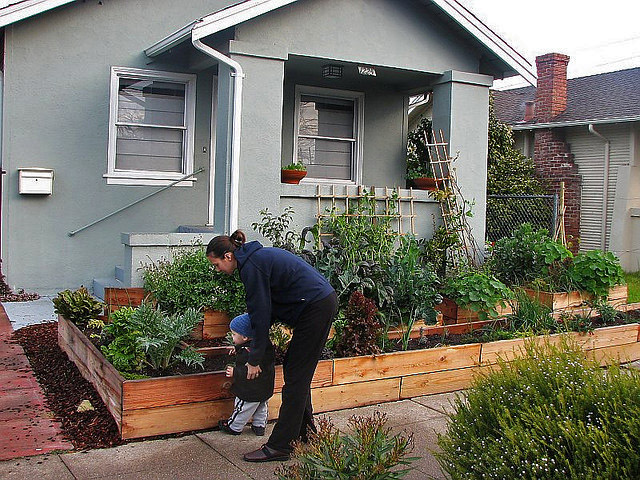
If you were on a quest to rid the world of excess turf grass, the front lawn would be a good place to start. No one does anything with their grassy front lawn except mow it. Back yards are far more amenable to relaxation and play—they’re sheltered from the noise of the street, protected by a large, immobile structure, the house. Front lawns dominated by grass are, for the most part, wasted space. This also makes them the perfect place to start developing ecologically sound landscapes in cities. But a quick trip through nearly any city, small or large, in the United States and Canada reveals the size of the fight ahead. In the front yard, lawns still rule.
It doesn’t have to be that way. Though most tend to toe the line when it comes to front yard lawns, people are surprisingly open to alternative landscaping, with one proviso—that it’s not a messy mass of weeds. Joan Nassauer showed this in her pioneering work in the early 1990s. In it, she presented seven types of simulated front yards to over 200 people from the Minneapolis-St. Paul suburbs and asked their opinions. About a third of those people had some knowledge of native plants while the others did not. Treatments ranged from conventional turf grass to messy weeds to native prairie and more. While the less knowledgeable people tended to prefer conventional lawns, they were amenable to yards with 50 percent native prairie grasses. The key to buy-in amongst non-floraphiles was a yard’s overall orderliness. Native grasses were deemed attractive provided that they were bounded by neatly trimmed turf grass.
 Clearly, people are not as wedded to turf grass front lawns as we might suspect. But translating that open-mindedness into action is another task entirely. One Canadian study suggests that people are hesitant to break free of the lawn for a number of reasons. Peer pressures is high on the list. If your neighbor has a mowed lawn, you’re more likely to have the same. But beyond social compulsion, physical structure of the neighborhood plays a role. Older neighborhoods with small front yards and tall trees tend to have more “alternative” front yards, because smaller yards lend themselves to more creative landscaping and homeowners may not want to own a lawnmower to tend a tiny strip of grass. Finally, tall trees in older neighborhoods make growing grass notoriously difficult. There were a few problems, however. Alternative front yards were not common, and where they were, grass was most often replaced with non-native ornamentals.
Don’t take those results as gospel, though. You may have noticed that I used a lot of qualifiers in the previous paragraph. That’s because the study it summarizes is rife with shortcomings. Many of those are probably to be due to the date of publication, 1998. While sophisticated geographic information systems (GIS) and statistical packages were available then, their use wasn’t widespread. The study’s authors had the right ideas, and if the study were redone today with updated methods, the results would be far more convincing.
Here’s why. The researchers mapped front yards and classified them by type of planting—20 percent or less turf grass, 40 percent or less turf grass, and everything else—but then failed to apply any spatial statistics to quantify the city-wide distribution of alternative yards. They also estimated road widths and lawn sizes, but only in relative terms. Such data would be relatively easy to come by these days, either with GIS layers or the use of laser range finders. Nor did the authors associate their data with census tracts or tax records, which would have added meaningful socioeconomic dimensions to their analysis. In short, the paper feels like an old ecology paper—lots of qualitative observations with little hard data to support their conclusions.
That’s not to say the authors don’t propose some insightful reasons why alternative lawns appeared where they did: Tall trees give a sense of enclosed space, which may encourage people to make an “outdoor room” of their front yard. Small parkways between the sidewalk and road are easier to landscape than large ones, thus fostering grassless experimentation. And tiny yards make homeowners ask, “Why bother mowing?”
It may seem like I’m at war with the lawn and turf grass in general. I’m not—in fact, I’m a bit of a fan. Rather, I’m arguing against useless lawns. I firmly believe that lawns play an important aesthetic and recreational role in cities. It’s just that front yards don’t play that role very well. They don’t support recreation in the same way back yards do—for example, it’s easier to play catch when you don’t have to worry about a ball rolling into the street. And regarding aesthetics, it’s clear that lawns do not have to be entirely turf grass to be socially acceptable. The key is care, as Nassauer would say. People welcome nature in the city so long as its curated. Think of turf grass front yards as blank canvases—I use that cliché because I mean it somewhat literally. So long as front yards are matted and framed by kempt grass, we are free to plant whatever we like. I say it’s time to start painting with something other than a turf grass brush.
Sources:
Henderson, S. (1998). Residential lawn alternatives: a study of their distribution, form and structure Landscape and Urban Planning, 42 (2-4), 135-145 DOI: 10.1016/S0169-2046(98)00084-X
Nassauer, Joan Iverson (1993). Ecological function and the perception of suburban residential landscapes Managing Urban and High Use Recreation Settings, General Technical Report, USDA Forest Service North Central Forest Exp. Sta., St. Paul, MN., 55-60
Photo by hortulus.
Related posts: