
Over the last 30 years, wealth in the United States has been steadily concentrating in the upper economic echelons. Whereas the top 1 percent used to control a little over 30 percent of the wealth, they now control 40 percent. It’s a trend that was for decades brushed under the rug but is now on the tops of minds and at the tips of tongues.
Since too much inequality can foment revolt and instability, the CIA regularly updates statistics on income distribution for countries around the world, including the U.S. Between 1997 and 2007, inequality in the U.S. grew by almost 10 percent, making it more unequal than Russia, infamous for its powerful oligarchs. The U.S. is not faring well historically, either. Even the Roman Empire, a society built on conquest and slave labor, had a more equitable income distribution.
To determine the size of the Roman economy and the distribution of income, historians Walter Schiedel and Steven Friesen pored over papyri ledgers, previous scholarly estimates, imperial edicts, and Biblical passages. Their target was the state of the economy when the empire was at its population zenith, around 150 C.E. Schiedel and Friesen estimate that the top 1 percent of Roman society controlled 16 percent of the wealth, less than half of what America’s top 1 percent control.
To arrive at that number, they broke down Roman society into its established and implicit classes. Deriving income for the majority of plebeians required estimating the amount of wheat they might have consumed. From there, they could backtrack to daily wages based on wheat costs (most plebs did not have much, if any, discretionary income). Next they estimated the incomes of the “respectable” and “middling” sectors by multiplying the wages of the bottom class by a coefficient derived from a review of the literature. The few “respectable” and “middling” Romans enjoyed comfortable, but not lavish, lifestyles.
Above the plebs were perched the elite Roman orders. These well-defined classes played important roles in politics and commerce. The ruling patricians sat at the top, though their numbers were likely too few to consider. Below them were the senators. Their numbers are well known—there were 600 in 150 C.E.—but estimating their wealth was difficult. Like most politicians today, they were wealthy—to become a senator, a man had to be worth at least 1 million sesterces (a Roman coin, abbreviated HS). In reality, most possessed even greater fortunes. Schiedel and Friesen estimate the average senator was worth over HS5 million and drew annual incomes of more than HS300,000.
After the senators came the equestrians. Originally the Roman army’s cavalry, they evolved into a commercial class after senators were banned from business deals in 218 B.C. An equestrian’s holdings were worth on average about HS600,000, and he earned an average of HS40,000 per year. The decuriones, or city councilmen, occupied the step below the equestrians. They earning about HS9,000 per year and held assets of around HS150,000. Other miscellaneous wealthy people drew incomes and held fortunes of about the same amount as the decuriones.
In total, Schiedel and Friesen figure the elite orders and other wealthy made up about 1.5 percent of the 70 million inhabitants the empire claimed at its peak. Together, they controlled around 20 percent of the wealth.
These numbers paint a picture of two Romes, one of respectable, if not fabulous, wealth and the other of meager wages, enough to survive day-to-day but not enough to prosper. The wealthy were also largely concentrated in the cities. It’s not unlike the U.S. today. Indeed, based on a widely used measure of income inequality, the Gini coefficient, imperial Rome was slightly more equal than the U.S.
The CIA, World Bank, and other institutions track the Gini coefficients of modern nations. It’s a unitless number, which can make it somewhat tricky to understand. I find visualizing it helps. Take a look at the following graph.
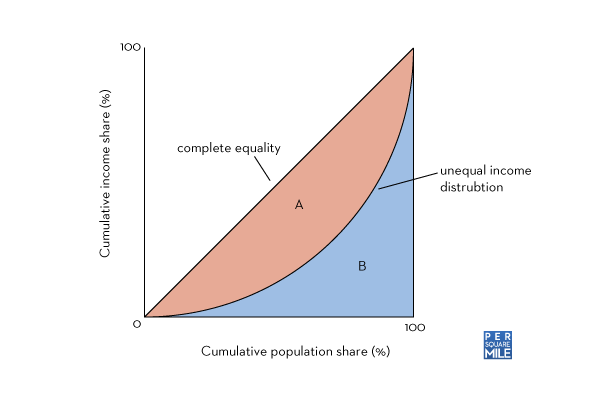
To calculate the Gini coefficient, you divide the orange area (A) by the sum of the orange and blue areas (A + B). The more unequal the income distribution, the larger the orange area. The Gini coefficient scales from 0 to 1, where 0 means each portion of the population gathers an equal amount of income and 1 means a single person collects everything. Schiedel and Friesen calculated a Gini coefficient of 0.42–0.44 for Rome. By comparison, the Gini coefficient in the U.S. in 2007 was 0.45.
Schiedel and Friesen aren’t passing judgement on the ancient Romans, nor are they on modern day Americans. Theirs is an academic study, one used to further scholarship on one of the great ancient civilizations. But buried at the end, they make a point that’s difficult to parse, yet provocative. They point out that the majority of extant Roman ruins resulted from the economic activities of the top 10 percent. “Yet the disproportionate visibility of this ‘fortunate decile’ must not let us forget the vast but—to us—inconspicuous majority that failed even to begin to share in the moderate amount of economic growth associated with large-scale formation in the ancient Mediterranean and its hinterlands.”
In other words, what we see as the glory of Rome is really just the rubble of the rich, built on the backs of poor farmers and laborers, traces of whom have all but vanished. It’s as though Rome’s 99 percent never existed. Which makes me wonder, what will future civilizations think of us?
Source:
Scheidel, W., & Friesen, S. (2010). The Size of the Economy and the Distribution of Income in the Roman Empire Journal of Roman Studies, 99 DOI: 10.3815/007543509789745223
Photo by Biker Jun.
Related posts:
Population density fostered literacy, the Industrial Revolution

Do they mean “large-scale *state* formation”?
If so, the authors are essentially stating that this vast majority did not benefit at all from the rise of the Roman Empire. If so, perhaps its collapse left them none the worse off!
Of course income inequality wasn’t as bad in Rome as it is in America, Rome was a pre-industrial society. In addition, while there was slavery and all kinds of economic injustices within the Roman empire, the Romans had a lot of what we would call “social program”, designed to provide for the poor.
But yes, of course what we see is the “remains of the rich”, that’s what we see everywhere in terms of archaeology. After all, we define “rich” largely by ownership of property, and in terms of archaeology what we are looking at is the remains of property. Poor people are people with no property, thus they had nothing to leave behind for us to find…
But this was always something my dad was keen to point out when we visited or saw anything on tv about palaces or churches or castles, etc. Yeah, these things are very impressive, but remember, they were owned by a few families and built by thousands of people who likely lives pretty miserable lives. It took thousands of miserable people to built the wealth enjoyed by the few, these weren’t things that average people were able to enjoy, these palaces aren’t indicative of a society of well off people, they are indicative of a society of oppressed people…
> Of course income inequality wasn’t as bad in Rome as it is in America, Rome was a pre-industrial society. In addition, while there was slavery and all kinds of economic injustices within the Roman empire, the Romans had a lot of what we would call “social program”, designed to provide for the poor.
More to the point, a pre-industrial society *can’t* be as inequal as industrial societies can easily be.
In order for a Roman society to support a relative Bill Gates concentration of wealth, that’d imply that most of the rest of the Roman society was starving to death. Yesterday.
Wealth can’t accumulate to an indefinite extent because at some point people start descending below the subsistence wage and start dying off. These days, growing wealth means inequality can grow at a fast clip without much of a change in the plebe’s standard of living – note that Cowen titled it the Great *Stagnation*, not the Great Die-off.
This comparison to Rome may be amusing, but it’s so apples and oranges it’s not funny for very long.
(Exercise: find a industrialized society with per capita above, say, $10k, which has ever been as economically equal as Rome is suggested to have been.)
Sweden. The UK. France. The Netherlands. And more. There are quite a few countries with high GDP per capita and Gini coefficients below 0.42. I get your point that industrialization allows for greater concentration of wealth, but there are plenty of countries that prove that doesn’t have to be the case.
Which kind of proves the point; the cited countries all achieving it by massive redistribution, papering over the normal inequality – more bread and circuses (let’s not forget the ‘bread’ part) than Rome was ever able to do.
Pingback: The United States has more than double the level of wealth inequality than the Roman… | Kalex's Tome
The income gini is not necessarily a good measure of inequality for the Roman empire. Roman wealth was highly illiquid, for one thing. But more importantly, ancient societies were often close to the “extraction frontier” – the elites extracted so much from the lower classes that the these were left basically at the minimum subsistence income – their income inequality was basically as high as it could possibly be. See Branko Milanovic’s work: http://www.nber.org/papers/w13550. On the other hand, that does not detract from your point that income inequality in the US is high by the standards of contemporary industrialized countries, even if there are countries out there with higher income ginis.
Pingback: Ancient Rome Had Less Income Inequality than Modern America | SmartPlanet
Pingback: » Empyre Epicene Cyborg
Many of the great monuments of Rome that we can still see today were built yes, largely by slave labor, but their use was definitely for the public good. Aquaducts, circuses, temples, fora, roads, public baths and the Colosseum itself are some such examples. These were funded by the treasury, usually, or a high ranking individual, but they were intended for use by ALL. Their construction would have also employed a large number of middle class freemen or citizens like engineers, artists and masons. Add to this the grain dole and intermittent debt forgiveness at the whim of an emperor, and you have what some Americans would consider a socialist society!
Wow. Now there is a great argument. Slavery is justified so long as it is for the public good. Sounds like national socialism to me.
I’m not justifying slave labor, just responding to the post that implied that these structures were build by a rich individual for the pleasure of that individual and his family alone. Yes, slave labor was exploited in the ancient world. But many of the monuments Rome built were for the public, not just an individual. Would it have been better if they had employed union construction workers and paid them a living wage? Sure, but that’s kind of water under the bridge now, isn’t it?
Yeah, but you’re judging it from the perspective of a society where slavery is a universal crime. In ancient times, it was the opposite: slavery was a universal practice. For a society to harness slave labor (and paid labor, too) for the benefit of the public was rather exceptional, at least on the scale that the Romans did it. Many Roman public works projects were built by free citizens, not slaves (who were rarely suited for that kind of work), and were funded entirely out of pocket by wealthy Roman aristocrats in an effort to contribute something to the public good. The Roman roads and aqueducts are great examples of this.
“Slavery is justified so long as it is for the public good. Sounds like national socialism to me.”
Actually, it sounds like the U.S. Founding Fathers, but whatever . . . people like to have selective knowledge about the sacred, all-knowing, morally incorruptible founders.
Reminds me of the anecdote left by Josephus–the one that tells of Pontius Pilate taking funds from the Temple to finance the construction of an aqueduct to serve Jerusalem. From Pilate’s perspective, the money was otherwise lining the pockets of the already rich priestly class. Yet, the act spurred riots among the commoners.
Pingback: Roman Empire More Equal than the United States — Marginal Revolution
“Which makes me wonder, what will future civilizations think of us?”
They’ll think we’re idiots for ignoring global warming, is what they’ll think. There’s one big difference inbetween our world and every empire that went before us — we are destroying the planet. We are leaving more than ruins. We are leaving an eventual 20-meter rise in sea levels, among numerous other effects.
And there’s a 50% chance that they’ll consider us silly for worry about global warming.
I’d say 50 percent is pretty optimistic in that case. The chance of global warming not becoming a concern is very, very low.
Pingback: Links 12/18/11 « naked capitalism
The Gini for the USA is certainly high. It tends to be significantly higher mainly in African countries where the current dictator takes as a matter of course that his income and wealth is identical with that of the state. Of course, in Rome, recurrent debt cancellation straightened things out, if only temporally, but not for slaves. Don’t know what things were like in the pre-industrial city state of Athens, but Plato suggested that a fair distribution of income should allow for a 4:1 ratio for top earners against the income of the ordinary bloke. Can’t see our contemporary banksters agreeing to that
Pingback: Wealth Inequality Slightly Worse in U.S. Than in Ancient Rome : Sierra Voices
Isn’t the important issue the living standards of the poor – not the difference between rich and poor? For poor people, if their income rises, their life improves. Whether Warren Buffett has 1 thousand times their income or 1 million times their income – who cares?
If there was something you could do that would increase the income of all poor by10% and the income of the rich by 100%, would you do it? Of course you would. Everyone is better off. The difference between rich and poor grows wider, but the living standards of the poor rise – which is the real issue.
A recent study showed that in the 1990s, the rich became richer and the poor became poorer – after inflation – but the economy overall was good and most people were happy.
In the last decade, both the rich and poor improved their incomes after inflation. But the economy overall is struggling. Today we have the Occupy movement – not because of the difference between rich and poor, but because the economy overall has problems, because more people are unemployed, and because of perceived unethical practices of some big companies.
The point is that we have the Occupy movement when the difference between rich and poor is not widening as fast as it was a decade ago.
There is another difference between today and the Romans. Most of the Romans lived off the state. Today, most of the rich people made their wealth entirely by themselves by building a business or investing effectively. 87% of the Forbes 400 richest Americans made their billions by themselves.
In the process, most have provided us with valuable products and services. There are many more tools for people to be able to build wealth themselves today. Becoming a multi-millionaire is not necessarily that hard today, by building a business or by investing effectively.
What are the recommended solutions? If the issue is the difference between rich and poor, the only way to really narrow that is to make the rich poorer. The most effective methods probably would be to tax the rich and force them out of our country, to make laws making it difficult to build businesses, or to discourage investment. What would narrow the difference between rich and poor more than these strategies?
But wouldn’t that be bad for everyone?
I think we should focus on the real issue, which is the living standards of the poor – not the difference between the rich and poor.
Ed
On the contrary, I think the difference between the rich and poor is an important statistic. Americans are working harder than ever—worker productivity has risen in recent decades—but they’re not receiving income increases commensurate with their contributions to the economy. Those seem to be going to the wealthy. Why should only one group of people benefit from the work of many? Why shouldn’t poor people share in this country’s success? I have yet to see good answers to those questions.
When it comes to the Forbes 400, sure many of those people worked hard and made their billions “by themselves”. But many also had the advantage of receiving a good education, much of which was probably paid for by their parents, who had adequate means. Improving the lot of the poor requires that they have access to quality educations—not just K-12, but post-secondary as well. The skyrocketing cost of a college education is a substantial barrier to class mobility.
And what’s one the primary drivers behind rising education costs? Decreasing government funding. State schools used to be far more affordable than they are today. What’s one way to ensure schools remain well funded and accessible to larger portions of society? Return tax rates to where they were decades ago when we were building universities hand over fist.
The Occupy movement has been building for years, I suspect, not just since the start of the recession. The recession likely brought it to a head, but the gulf between rich and poor—which is still growing, as you point out—has been sowing the seeds of this discontent. While Americans do have more opportunities for class mobility than ancient Romans did, that shouldn’t paper over the fact that meaningful upward mobility remains solidly out of reach for many Americans.
Please don’t confuse work productivity with increased worker efficiency.
Employers, NOT WORKERS, make the necessary capital improvements to make their workers productive. A person can only do so much at one time. What about the UAW that fights to make car companies less efficient by slowing down production lines?
DUH, some of the improvement in productivity is due to employer investment. Some of it is also due to employees investing in themselves through education and training. Some of it is simply due to society-wide technology improvements – the advent of the internet for example. There’s no reason for employers to have any monopoly on productivity gains. Also, very few “employers” are in the top 1%. For every multimillionaire tycoon entrepreneur there’s probably ten guys running their own gas station and another ten running a restaurant or bar. All of those little businesses employ a lot of people but their owners never get rich.
Goes back to the old anthropology argument: revolt happens not as a result of the magnitude of suffering, but as a result of the gap between expectation and perceived reality.
‘Today, most of the rich people made their wealth entirely by themselves by building a business or investing effectively. 87% of the Forbes 400 richest Americans made their billions by themselves.’
Really? They didn’t use roads, police, fire protection, education, the old boy network, protection from foreign invasion by the military, the courts, the political system. Really? All on their own, as if they were a country all unto themselves.
That is a complete fantasy.
You can’t run a Gini Coefficient in a slave economy where some people *are* wealth. It contradicts the premises of the measurement that everyone owns himself. If a person, then the slave owns zero wealth; if an asset, then the slave’s value belongs to someone else. In either case, you can’t argue for the slave-GC as an index of social welfare.
Of the top 20 in the Forbes 400 (actually 22 counting ties), 9 inherited, and 4 are gamblers. It’s harder to identify the inheritors as you go down the list, but the number of innovators like Gates and Bezos fall off, and more and more look like real estate and finance. In other words, not innovators, not job creators.
http://www.forbes.com/forbes-400/list/
Personally, I think the country would be much better off if the creepy Waltons and the Mars family just left and moved somewhere they’d be happier.
I just love statistics.
I can make up any number I want.
What does the number “top 1%” mean??
Is it Individuals? Households? Families?
Does it make sense to count the welfare cognoscenti that rely on taxpayers to pay for their lifestyle?
types of currency play a larger factor than one would think. Romans had silver and gold, all of it occupying physical volume and weight. Most people’s wealth (rich or poor) would have a real ceiling, or limit, in accumulating and managing these currency tokens.
In today’s world, the 1% no longer have a physical wealth ceiling as ‘digital’ wealth can grow forever. Its a real concern as all things are not equal when comparing these two ‘empires’. Any given Roman would have no doubt “hoarded” more wealth if they could.
I would love to see a follow-up study tracking the geneology of those who managed to escape the fall of the Roman Empire north with their wealth and whether those same families have been able to retain their status and how they built on it.
Pingback: WeMustChange » Blog Archive » Study: Income Inequality In America May Be Worse Than It Was In Ancient Rome
This study is bunk.
“The ruling patricians sat at the top, though their numbers were likely too few to consider.”
Considering that much of the empire was the Emperor’s personal property (e.g. the entire province of Egypt), the Roman Empire was one of the most unequal economies in western history. If you’re going to exclude that wealth, then there’s no point in making the comparison.
stripping the MIddle Class hurts the poor more than anything. the Rich have never considered anyone else but themselves. Building the Monuments and Coliseum et al were all glorifications and constructions built to reinforce their “society” and their rule in that society.
Roman Elites built things that also benefitted the poor. Since the ’80′s the Rich and Poor inequity has only increased. The American Rich take all the MONEY out of America. The American Rich don’t invest in America. There’s no concept of the Poor as existing for the Rich to ever bother about.
The Middle Class is responsible for and has helped the Poor better themselves, it’s the MIddle Class that spends money, not the Rich. At least not in America anymore. Not since the Trickle Up Economics of
St. Reagan.
Now that the Rich have destroyed the Middle Class and the American economy, it will take a “New” economic engine for the Prosperous Times to return to the American Empire
Pingback: American Income Inequality Greater than that of the Roman Empire | The Advocate
Pingback: Study: Wealth Inequality In America May Be Worse Than It Was In Ancient Rome | Greediocracy
Pingback: U.S. Income Inequality Higher Than Roman Empire's Levels - Democrats, Republicans, Libertarians, Conservatives, Liberals, Third Parties, Left-Wing, Right-Wing, Congress, President - City-Data Forum
The question here is not what the future generations would think about is but what sort of society are we creating. The kind of materialistic Society which we have created has the seeds of its destruction in built into it.
I am from India and I can convincingly tell you that there are two India’s one which struggles for 2 meals a day and another who go for foreign vacations, buy islands have wealth stashed in Swiss Banks. One day these two would clash. And this is what I fear most!!!!!!
Pingback: U.S. Income Inequality Higher Than Roman Empire’s Levels: Study « Aotearoa: a wider perspective
Pingback: Income inequality in the Roman Empire « Per Square Mile « All American Truth
This article was interesting but I found the measures used for calculating the wealth of the Romans very vague. If we consider the emperor had control over all the lands of the empire and he designated them to whoever he pleased than that inequality would never be comparable to the United States. Also, the income from nowadays cannot be compared with the income from Roman times. In Rome, “money” was not as important as nowadays, since you had to be from a respected family or have influencial friends to live any sort of good life.
Pingback: Mid-Week AM Reads | The Big Picture
To compare equality you can’t just include tangible wealth. You also have to include intangible wealth. For example in Ancient Rome, the wealthy had far more rights than a poor person. Moreover, Rome was a violent and unsafe society. A wealthly person could afford security, where a poor person could not – i.e. walled compounds, private guards etc… A poor person was much more likely to be killed or murdered or robbed Today, a poor person has about the same security as a wealthy person since the whole society is relatively safe. Therefore, a poor person today has much more wealth relative to rich people than in Rome.
Also by the 3rd century AD, poor people in rural areas were already tied to the land and to their father’s profession based on the edicts of Diocletion. That had very little freedom.. How much is that worth?
In our society today, the 99% has almost the equivilent intangible wealth relative to the 1%. For example, the existence of cell phone networks, or drug patents, or food distribution networks, etc while “owned” by the 1% can be used by the 99% for a small fee. On a relative basis, the value of that intangible is far greater to the 99% than the 1%. In otherwords, the wealth of the 1% is already redistributed via these large intangibles to the 99%. In return, the 1% reinvests the income earned from the 99% into new industries and technologies, which again benefit the 99%, and the cycle repeats itself over and over. If you create a policy to redistribute tangible wealth it may result in the production of less intangible wealth resulting in the eintire society being poorer, both rich and poor.
In contrast, when you have a society mostly based on land ownership, such as Ancient Rom, the 99% don’t really benefit at all from the assets owned by the rich.
In our society, the wealth that needs to be redistributed is wealth that is squandered by rich people. This is not the wealth owned by Bill Gates or corporations, which is redeployed as products to the middle class. It is the wealth tied up in things like useless land purchases by Ted Turner in Montana who do nothing with their land other than hold it for some ideological belief.
There were times in Ancient Rome when it was more arguable that wealth was redistributed more fairly than our society today That existed in the Republican era prior to the war with Greece. Following the war with Greece, the massive influx of slaves greatly increased the wealth of the aristocrats relative to the plebs. The plebs were kicked off their land and lost the wealth they had accumulated in prior generations.
It seems to me the biggest difference between the wealthy people of ancient times and the wealthy people of today is the degree of involuntary servitude of the people who support them.
We can bitch all we like about the wealth of the top one percent today, but in many cases we are the ones who purchase the products that make these people wealthy. In many cases, we have the power to make or break the wealthy by virtue of our buying habits.
“…An empire built by conquest and slave labor”…………?
Does that rings a bell, anyone?
The Gini coefficient is in the news lately because it serves a particular political perspective, but it isn’t a very good measure of anything but income ‘inequality’. The first presumption is that income equality is a goal for a civilization, society and/or government.
Think about it from the point of view of baseball. A batting average of .300 isn’t very common. The choice given by most proponents of the Gini coefficient as proof that America is at some brink or that ‘income inequality’ is proof that capitalism doesn’t work is to hobble the batters who have achieved .300 thereby reducing their batting average and taking the extra percentage of batting average and distributing it evenly across the remaining batters in the entire league. Would baseball or any sport be better off if it’s star players were forced to strike out more often or if it’s weaker players were allowed an automatic base hit every once in a while to even things out?
Note Bene that I said specifically, ‘batters who have achieved .300′. There is a subset of high income earners who have done so by handicapping the rest of the field. They have achieved their high income through gaming the system and using the levers of government power to succeed. We’d call these guys cheaters in baseball – steroids users, bat corkers, etc. – in a modern economy they are crony capitalists. These are the real bad guys in the high income field. They cause a lot of strife and have gained income unnaturally, but through political corruption and the Gini coefficient doesn’t measure that.
Also, it isn’t income inequality per se that causes social tension, but it is the structure of that inequality that does. That is looking at 3rd World countries you see that the rich are largely made up of what Americans refer to as crony capitalists. If the movement between the income quintiles is fluid and largely based on merit then you don’t have any real, pervasive and permanent social tension. Remember that just a few years ago people were feeling good about the economy and that we are in a credit crisis with all the detrimental effects on employment. Credit crises are slow to resolve, thus increasing the pain. The point is that the political tension is is just that political. It serves the purpose of re-electing a sitting POTUS, not proving a structural defect in America or capitalism.
Now the Gini coefficient doesn’t distinguish between a free market income and the income of a crony capitalist. That measure would be much more telling than some arbitrary measurement of raw incomes and this brings us to the final nail in the coffin of the Gini coefficient as a measurement of anything.
For subsistence level societies, including Rome, the Gini coefficient makes some sense. If income is a zero sum game then those with more are quite literally taking from those with less, but this isn’t the case in a dynamic free market. Free markets by their nature produce innovations and surpluses. In America you see significant movement between income quintiles with significant falls and rises from between highest 20% and the lowest 20%. My personal example is from the lowest 20% as a child to the highest as an adult, all predicated on my personal choices for career and income.
Imagine the situation of Dr. Jones. Dr. Jones is a lone experimenter and proceeds to produce and patent a cure all. This pill must be taken every day, once a day and it costs $10/day. This miracle cure is in great demand, but for many its high cost isn’t attainable and they continue to suffer various and normal human illnesses. Only those wealthy enough to afford the pill can do so. Dr. Jones becomes a very, very high income earner, perhaps within the 1% of the 1%. Dr. Jones by himself causes income inequality to rise, yet at the same time the general welfare of the entire world rises through those very same efforts.
The results of Dr. Jones’ actions are a massive reduction in medical costs due to the fact that there is less demand for medical services among those wealthy enough to afford the pill. They never get sick, but those who are poorer and still get sick find it easier and more affordable than ever to get health care. That’s the free market and the Gini coefficient does not and can not be a true measure of individual welfare or the true nature of a society.
Our measure of poverty is arbitrary. One can still be poor in America yet have a television, automobile, a refrigerator full of food, a non-dirt floor, etc. The Gini coefficient is an abuse of statistics. Ask yourself why equality in income is even a goal?
Thank you for a well reasoned argument. You are one of the very few “sane” posters here.
Just a note: Ad hominem attacks on commenters, even indirectly, will result in a ban. I have to keep things civil or else comments will disappear.
This whole thing is really beside the point, because 40 of GNP comes from abroad. The best compensated are those who have figured out how to harness globalization, and that money is really untouchable by the US redistributionists. And, it is not all evil, as these same people are bringing the fruits of American ingenuity to vast emerging markets. So, when I bought a $15 crockpot, I realized I benefited from pricing that also brought it within the reach of thousands of new middle class customers in India, Chine, and Brazil.
As for the Roman Empire, they pursued a tax the rich” strategy until the senatorial land holders could not bear the tax burden anymore. So, they sought refuge in monasteries donating their land to them and taking poverty, chastity, and obedience vows. What started as tax shelters became the institution that preserved Western civilization throughout the Dark Ages.
Claire W Solt, PhD medieval historian
Pingback: As Rome fell; so will the USA « Shit Happens
The posters here are a prime example of Marxist ideology on display!
I can’t help but wonder if anyone here has an ounce of common sense backed by a strong classical education? I’d bet no.
In life, you can only provide equally available opportunities to people. It is called the equality of opportunity. The rest is up to the individual. Since each person is different as it pertains to their intelligence, motivation, education, family circumstances, etc., they will all attain different levels of successs as measured by wealth. I may be poor but a successful artist who prefers personal satisfaction over material goods. Who are you to tell the society that it is somehow at fault because I am not wealthy?
Equality of outcome as you Marxists want, require taking from others by force. Anyone who can philosophically justify that is both morally and intellectually corrupt.
I
Pingback: Weekly Round Up December 28 – 2011 | Connect the Dots
Pingback: Republicans Have a Gambling Problem | LA Progressive
Pingback: Livius Nieuwsbrief / januari « Mainzer Beobachter
Pingback: Faits divers No 7 « Blogue de Jean-Pierre Martel